The Car Turns Us into Bad Systems Thinkers
Traffic reveals how quickly private inconvenience can eclipse shared consequence, and how fragile flow becomes when everyone optimises locally.
 carlo kruger 02 MAY 2026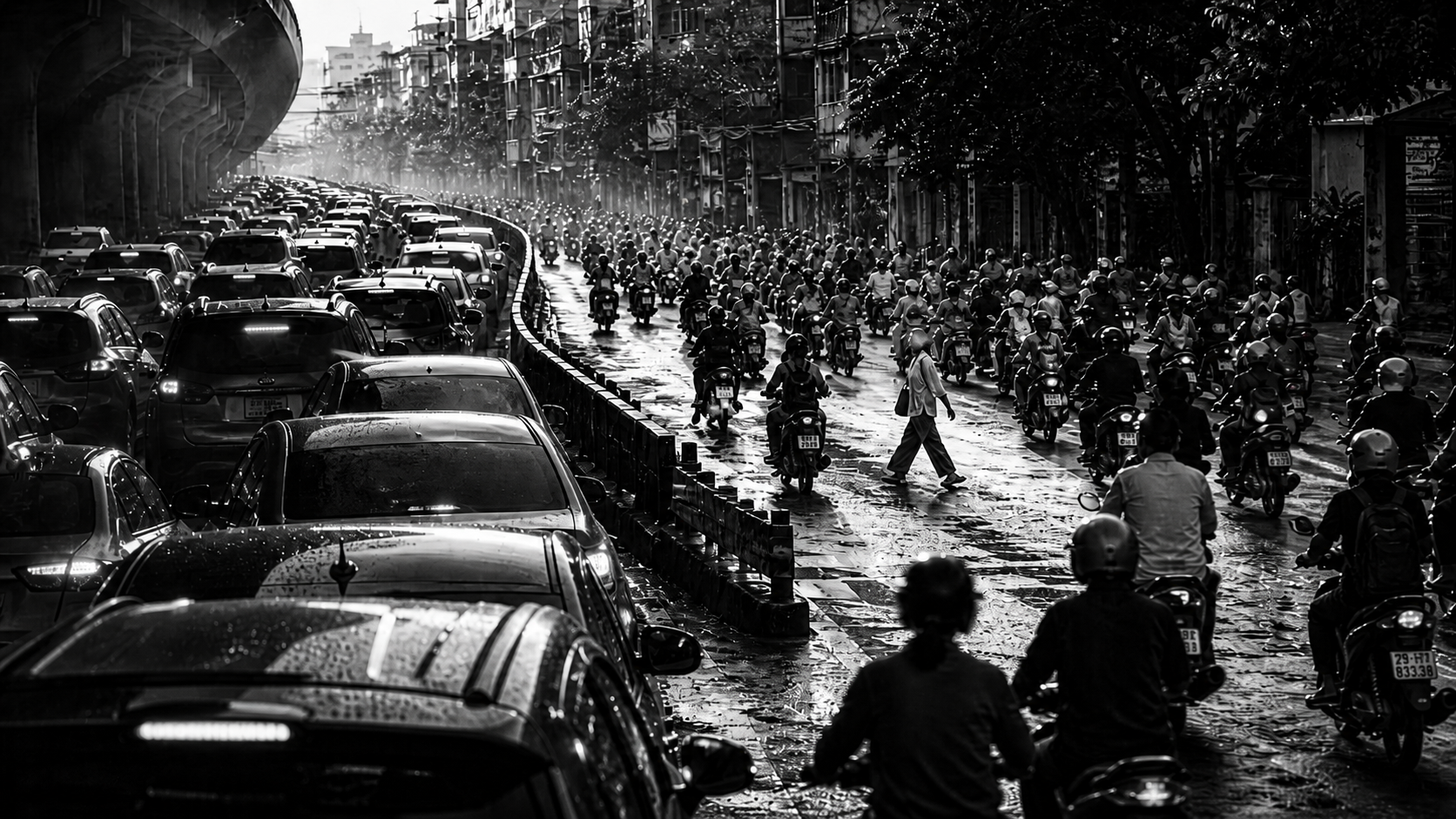
“Saigon. Shit. I’m still only in Saigon.” -Apocalypse Now
The line comes back to me sometimes in traffic, though my own circumstances are rather less cinematic. No jungle. No patrol boat. No Wagner rising over the trees. Only heat, brake lights, the faint smell of exhaust, and the slow spiritual abrasion produced by a line of cars moving in fits and starts along a road that ought, by all appearances, to be perfectly capable of carrying them.
There are few places where otherwise ordinary people become so quickly and so completely incapable of thinking systemically as a traffic jam. The transformation is almost comic. A person who can discuss fairness, cooperation, and the common good over dinner will, once sealed inside a car and made to wait a little too long, begin to think like a trapped animal. The gap ahead becomes charged with meaning. The queue becomes an insult. Every brake light feels personal.
And then someone tries to jump the line.
They come up the side where they should not be. They ignore the lane they ought to be in. They nose in late at the narrowing point as if the system exists for everyone else, but not for them. The reaction this produces is immediate and curiously ancient. It is not merely annoyance. It is outrage. Something in us recoils from the small act of theft. The offender may gain only a few metres, a few seconds, hardly anything measurable in the grand scheme of things, and yet the response they provoke is disproportionate, almost primal. They have taken a private benefit from a shared system and pushed the cost outward onto everyone else.
Traffic, in this way, is a moral theatre. It strips social life down to turn-taking, proximity, grievance, anticipation. It exposes something we prefer not to know about ourselves: once we are inside a system under pressure, our commitment to the whole becomes alarmingly fragile. We believe in fairness right up until the point at which fairness delays us.
Then we begin scanning for a gap.
What is shared on a road is not merely space. It is time. Or more precisely, it is the system’s capacity to move many people through space with some tolerable degree of predictability. The road is a commons, certainly, but the thing held in common is not just a strip of tarmac. It is passage. It is flow. The real theft in traffic is not always of position but of rhythm.
And flow, as anyone who has spent enough time trapped in traffic knows, is a fragile thing.
It does not always take a dramatic obstruction to destroy it. A lane closure will do it. So will an accident, or a robot out at the wrong intersection, or a surge of vehicles trying to enter where the stream already has little spare capacity to absorb them. But often the damage is subtler than that. A brake tap becomes a wave. An aggressive merge becomes a cascade of overcorrection. One driver’s little act of local cleverness ripples outward until dozens of other people are paying for it. The system loses rhythm. It clenches. What looked, from the inside, like a small piece of personal ingenuity becomes, from above, a tiny contribution to collective stupidity.
This is one of the things traffic reveals with unusual clarity: the difference between what feels rational at the scale of the individual and what is actually good for the system. We are not very good at living inside that difference. Or rather, we understand it perfectly well in the abstract and very poorly when our own inconvenience enters the picture. Once delay becomes personal, the whole becomes harder to see.
I have often thought of this in relation to Saigon, the first time I encountered the traffic there and burst out laughing. It arrived not as traffic in the usual sense, but as a torrent: scooters, motorbikes, cars, pedestrians, all of it in motion at once, a moving density that seemed, at first glance, far too chaotic to produce anything except mayhem. The first impression was disbelief. The second was delight. The third, if one sat with it long enough, was something like intellectual embarrassment. It worked.
Or rather: it flowed.
Not with the brittle order of neat lanes, formal intervals, and stop-start obedience, but with the fluid intelligence of a stream finding its way around stones. Bruce Lee’s old injunction comes back to mind: be like water. It is one of those phrases that risks sounding trite through overuse until one suddenly sees, somewhere in the world, what it might actually mean. Water does not abolish constraint. It does not take offence at the shape of the channel. It meets what is there, yields, adjusts, finds the line of least resistance, keeps moving. It does not lurch and seize and demand that reality make a special exception for it.
That, to me, was what Saigon’s traffic seemed to understand. What held it together was not rigid control but legibility. A pedestrian crossing the road does not dart, does not hesitate, does not perform panic for the benefit of oncoming vehicles. They step into the stream and move at a steady pace. They make themselves readable. And the traffic, astonishingly, bends around them.
What looks from a distance like disorder turns out, on closer inspection, to be a form of coordination. Not perfect coordination. Not saintly cooperation. Something more ordinary and perhaps more impressive than either: countless agents adjusting to one another in real time because their movements remain interpretable. They do not need to agree about everything. They need, above all, not to surprise one another.
That seems to me a better description of social order than many tidier theories manage. We often mistake order for rigidity, and chaos for fluidity. But a rigid system can be remarkably fragile, while something that looks chaotic can possess an adaptive grace. One clots; the other flows.
This is why the small disciplines of traffic matter in ways that are easy to underestimate. A speed limit is not merely a legal imposition; it is one way of reducing dangerous differences in pace. Lane discipline is not just etiquette; it is a means of minimising conflict. Even a merge, that little recurring drama of entitlement and capitulation, works best when it is governed by something more reliable than each driver’s private emotional weather. Where people share a rule, or even a stable heuristic, the merge becomes less of a contest and more of a rhythm. Where they do not, it becomes a negotiation under pressure, and a negotiation under pressure quickly degenerates into noise.
There is something almost absurdly revealing about how furious people become at the merge point. Everybody believes in the common good at cruising speed. The test begins at the narrowing lane.
That is where the moral psychology becomes impossible to miss. The queue-jumper is offensive not only because he is rude, though he is. He is offensive because he takes advantage of a shared system while pretending, by his actions, that his urgency is somehow special. Human beings appear to have a very old and very sensitive set of instincts around this kind of thing. We are exquisitely alert to freeloaders, to queue-jumpers, to people who take the benefit while externalising the cost. Traffic turns that instinct into a fucking siren.
And yet there is an irony here. The queue-jumper is not outside the system. He is trapped inside it too. His little act of self-advancement contributes, however minutely, to the degradation of the very flow on which he depends. This is the deeper lesson, and perhaps the more uncomfortable one. In shared systems, selfish cleverness so often produces collective stupidity. The person lunging for advantage is not escaping the system but helping to poison it.
It is easy, of course, to turn this into a story about bad people. There is some satisfaction in that. It gives the traffic jam a villain, and villains are always a relief. But the real problem is less flattering because it is more democratic. The traffic jam is not mainly the result of monsters. It is the result of ordinary people, under mild pressure, becoming less able to feel the reality of the whole. It is the result of attention narrowing until private inconvenience starts to eclipse shared consequence.
This is also why constraints matter, despite how often they are misdescribed as mere bureaucracy or petty interference. Good constraints are not the enemy of flow. They are often what make it possible. A rule about lane use. A shared understanding of who yields and when. A metered release into an already crowded stream. These things feel, from the inside, like delay, like denial, like the infuriating refusal of the universe to acknowledge that one has somewhere to be. But the point of the constraint is not moral uplift. It is variance control. It is the reduction of surprise at precisely the points where surprise does the most damage.
The same is true of slack, that despised little buffer modern impatience finds so offensive. Nothing looks more wasteful to the frustrated driver than a bit of open road between cars. Surely that gap should be occupied. Surely we should all be packed a little tighter, pressed a little closer, making full use of the available space. And yet anyone who has spent enough time in traffic knows what happens when there is no breathing room at all. The smallest disturbance amplifies. The mildest correction becomes a chain reaction. A system with no slack loses its capacity to absorb shocks. It becomes brittle. It moves, if at all, in convulsions.
This too feels truer than traffic.
There are many domains in which people mistake saturation for efficiency. The full diary. The stacked queue. The life in which every available unit of time and attention has already been claimed. It looks impressive from a certain managerial altitude, as a fully occupied road might look efficient on paper. But lived from within, it is something else: tense, brittle, permanently on the edge of seizure. It has no room to recover, no room to adapt, no room even to remain graceful in the face of the ordinary disturbances that are the texture of life rather than an exception to it.
I have noticed, in traffic, that if I leave enough room ahead of me and aim not for bursts of progress but for continuity of movement, something curious happens. Often the car behind me begins to do the same. The pattern propagates. Not always. One should not romanticise it. There is always someone eager to colonise any visible patch of space, as if unused distance were a moral failure that had to be corrected at once. But often enough the steadier rhythm catches. The line softens. The compulsive lurching eases. For a moment, the system begins to resemble a flow again rather than a series of grievances.
That may be one of the few hopeful things traffic teaches. Behaviour spreads. So does calm. So does panic. So does selfishness. A system is not merely an aggregate of private decisions. It is a medium through which habits move.
There is a line in Apocalypse Now that has always seemed to me one of the sharpest observations about modern institutions. Kurtz says that we train young men to drop fire on people, but their commanders will not allow them to write fuck on their airplanes because it is obscene. What gives the line its force is not merely the profanity. It is the precision with which it names our confusion about what really counts as an offence. We are often exquisitely sensitive to what is symbolically improper while remaining strangely numb to deeper obscenities built into the system itself.
Traffic has its version of this confusion. We notice the gesture, the insolence, the theatrical rudeness of the person who cuts in. We notice less readily the broader obscenity in which we ourselves are implicated: the routine degradation of a shared system by a hundred small acts of impatience, vanity, entitlement, and fear. The visible breach gets the moral charge. The underlying pattern goes on producing its damage quietly, democratically, with our participation.
This is why traffic feels to me like such a rich site of observation. It takes grand abstractions — fairness, cooperation, freedom, order, selfishness, constraint — and reduces them to a set of ordinary repeated choices made under mild pressure by people who would probably describe themselves as decent. And there, precisely there, one sees how fragile decency can be when made to queue.
We like to imagine that our failures in systems are failures of knowledge. If only people understood better. If only they could see the whole. If only they appreciated the importance of patience, or fairness, or the common good. But traffic suggests something harsher. Often the problem is not ignorance. It is that the moment the delay becomes ours, the temptation to defect becomes intimate and persuasive. The queue ceases to be a structure and becomes an injury.
The car turns us into bad systems thinkers because it traps us inside the scale of our own inconvenience. It makes the whole hard to feel.
And yet Saigon suggests another possibility. Not innocence. Not utopia. Simply flow born of adaptation: water around stone, movement through density, order emerging from readable behaviour under constraint.
Perhaps that is the final discomfort, and also the final hope. We are not condemned merely to clog. We are capable of learning forms of movement that do not depend on each participant treating the system as a personal adversary. We are capable, under the right norms, of becoming legible to one another. Of moving without lunging. Of yielding without surrendering. Of finding a rhythm that is not simply the sum of private impatience.
Still, the ordinary traffic jam remains one of the clearest little theatres of modern life. We sit in our lanes, metre by metre, glaring through glass, each convinced that the real problem is somewhere just ahead. Meanwhile the road tells a simpler truth. It can survive density. It can survive inconvenience. It can even survive a fair amount of selfishness. What it cannot survive for long is variability without discipline, freedom without legibility, or a commons treated as though no one really shares it.
And so we watch for the next gap, discovering again how much of civilisation depends on whether we can bear, for a little while, not to take it.