A Product Management Manifesto
I believe product management is a decision-making discipline under uncertainty, focused on reducing risk and learning quickly rather than shipping features on faith.
 carlo kruger 16 JANUARY 2026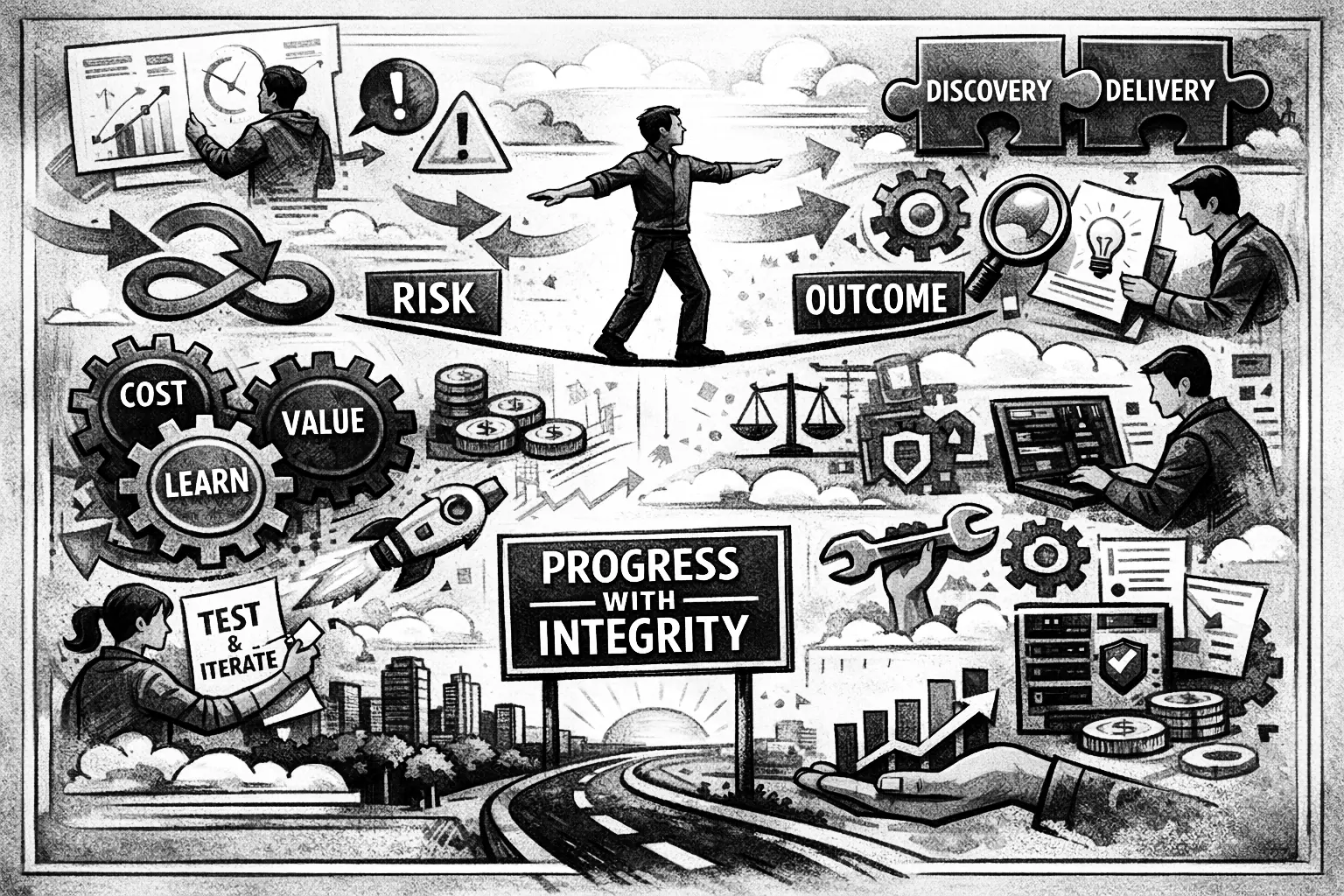
How I believe products should be built
**Product management is decision-making under uncertainty**
The primary job of product management is not backlog maintenance, roadmap creation, or stakeholder appeasement.
It is making responsible decisions with incomplete information.
Every product decision carries risk: customer risk, delivery risk, operational risk, and opportunity cost. My role is to surface those risks early, reduce them deliberately, and sequence work so that learning happens before commitment.
Certainty is not the goal. Progress with integrity is.
**Outcomes matter. Outputs are just evidence.**
Shipping features is not success.
Success is changed behaviour, improved system performance, or measurable business impact.
Roadmaps are hypotheses. Backlogs are instruments. Delivery is a means, not an end.
If we cannot articulate what outcome a piece of work is meant to move, we are not doing product management — we are doing theatre.
I optimise for time-to-learning, not time-to-launch.
**Discovery and delivery are inseparable**
Discovery is not a phase that precedes “real work”.
Discovery is the work.
The best teams run discovery and delivery continuously and in parallel:
- framing problems clearly,
- testing assumptions cheaply,
- and shipping the smallest slice that produces real signal.
Perfect knowledge is impossible. Sufficient confidence is enough — if we earn it honestly.
**Constraints are not obstacles. They are product requirements.**
Regulation, scale, reliability, latency, cost, operational load — these are not externalities.
They shape the product as surely as user needs do.
I treat constraints as first-class design inputs, because products fail more often from operational drag and trust erosion than from missing features.
A product that cannot be operated, supported, or explained is a broken product — no matter how elegant the UI.
**Economic thinking is part of product quality**
Not all work is equal. Timing matters. Sequencing matters.
I use economic reasoning — Cost of Delay, risk reduction, and optionality — to decide what to do next, not just what to do eventually.
Prioritisation without economics is just preference with better slides.
**Teams need clarity of intent, not control**
High-performing product teams require two things:
- Clear outcomes and constraints
- Autonomy in how they achieve them
I believe in trusting skilled engineers, designers, and collaborators to make good decisions — while holding the line on purpose, quality, and accountability.
Micromanagement is a failure mode of unclear thinking.
**Product quality includes operability and trust**
Reliability, auditability, debuggability, and safety are not “non-functional requirements”.
They are core product attributes, especially in regulated or high-risk domains.
If we cannot answer:
- “What happened?”
- “Who was affected?”
- “Can we undo this safely?”
Then we are borrowing trust we haven’t earned.
Measurement exists to guide decisions, not decorate dashboards
Metrics are only useful if they inform action.
I favour a small number of metrics that:
- map directly to user value or business outcomes,
- are instrumented deliberately,
- and answer specific product questions.
Vanity metrics create motion without progress.
Good metrics create humility.
**AI is an amplifier, not a substitute**
I actively use AI across product work — discovery, sense-making, prioritisation, communication — but I reject the idea that AI removes responsibility.
AI accelerates thinking. It does not replace judgment.
The human remains accountable for:
- framing the right problem,
- interpreting signals,
- and owning the consequences of decisions.
Automation without accountability is just faster failure.
**Product work is a moral activity**
Products shape behaviour. Systems shape incentives. Incentives shape culture.
I believe product managers have a responsibility to:
- be explicit about trade-offs,
- avoid hidden harm,
- and resist optimising short-term gain at the expense of long-term trust.
“Doing the right thing when it’s inconvenient” is not a slogan.
It is a design constraint.
**The goal is durable value**
I optimise for products that:
- last,
- can evolve safely,
- and make life easier for the people who use and operate them.
Fast is good. Sustainable is better.
Learning beats certainty.
Trust beats novelty.
That is how products should be built.
If any of this resonates, keep an eye on the-product-coach